![]() |
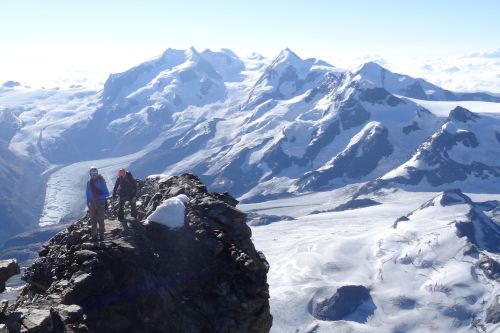
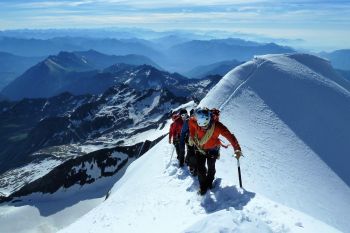
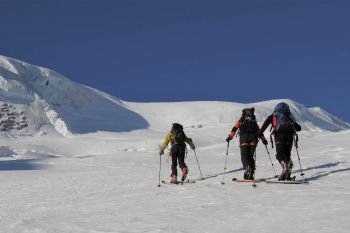
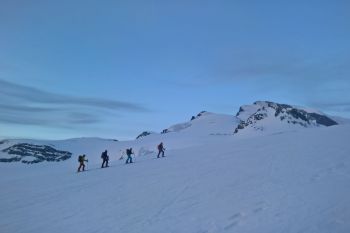
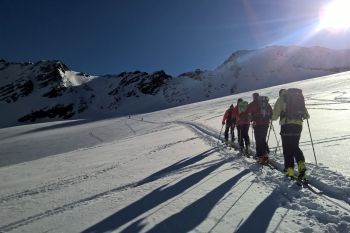
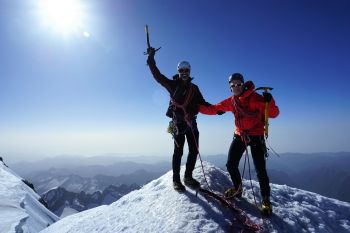
The peaks of the Bernese Oberland form the northern rampart of the Swiss Alps. They have a wilder and more remote feel than the Swiss Valais, with more snowfall, bigger glaciers and fewer mountain huts. With the exception of accessible peaks like the Mönch and Jungfrau, the high summits of the Oberland are major undertakings and hard-won, making them especially rewarding.
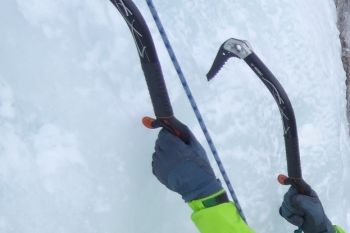
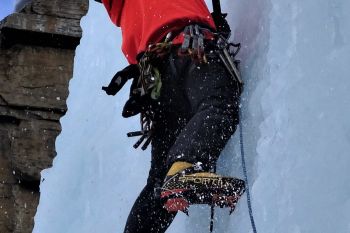
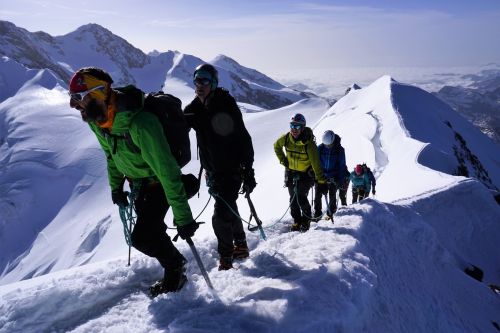
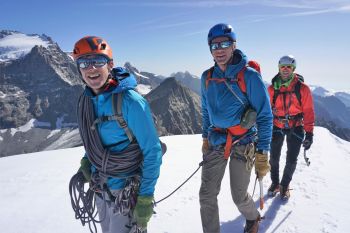
On this course, we attempt some of the finest Oberland summits, with the highest in the range – the Finsteraarhorn (4274m), as our principal objective. Other classic summits in the heart of the range include the Grunegghorn, the Gross Fiescherhorn, the Hinter Fiescherhorn and the Gross Grünhorn, all of which give challenging ascents involving up to 1400m of height gain.
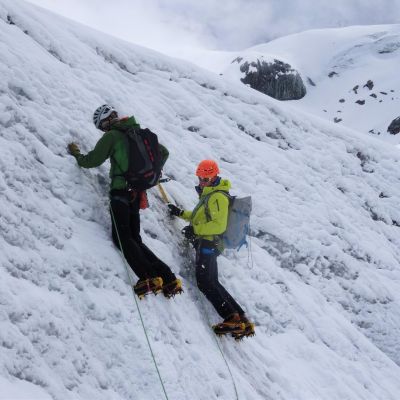
This will be a strenuous week demanding good fitness and general mountaineering skills. Previous alpine mountaineering experience is necessary (such as gained on an ISM Summits & Skills course). Our exact itinerary is normally finalised after taking into account any peaks that participants may have climbed previously.
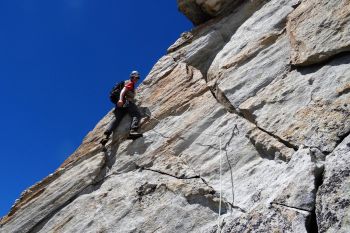
Who the course will suit Many of the climbs on this course are particularly long and/or remote, so a good level of stamina and aerobic fitness is essential. Participants should have previous alpine experience, preferably to 4000m. Competence with ice-axe and crampons is required, as well as the ability to climb at least to alpine grade II (American 5.3, UK Diff) in mountain boots with a medium-sized rucksack. Participants should have completed an ISM Summits and Skills course or equivalent. Routes climbed on this course are mostly PD to PD+. Peaks that can be climbed on this course
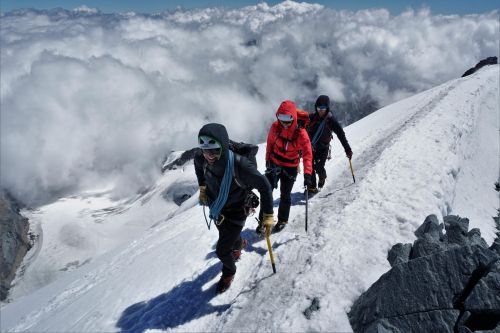
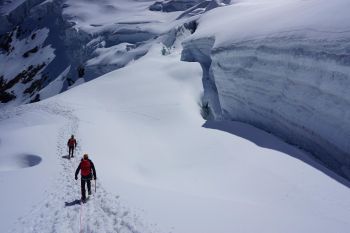
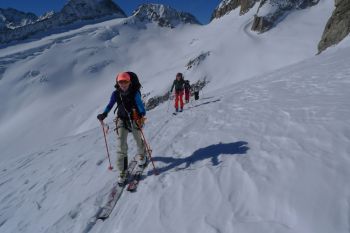
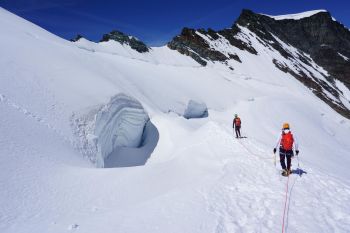
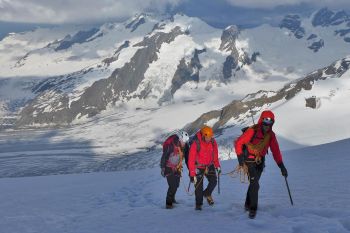
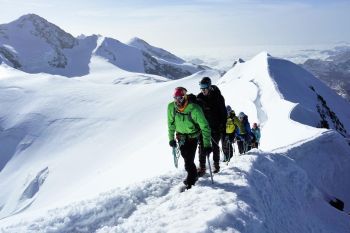
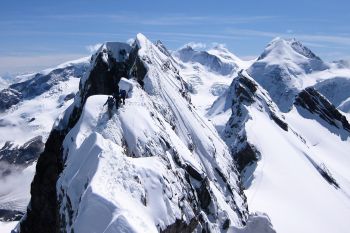
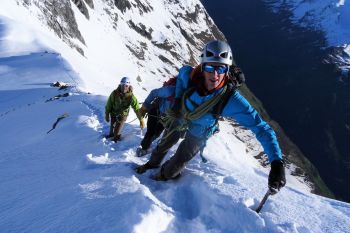
Typical course programme This is a sample programme as there are many different ways to combine these ascents. We will also adapt the program to make use of the best weather for our ascent of the Finsteraarhorn. In a week of poorer weather/conditions when the Finsteraarhorn may not be possible, we can still have a great week's mountaineering based mainly at the Mönchsjoch hut. Saturday evening. The course starts with participants and guides meeting at 7.00pm at Le Grand Chalet hotel in Leysin. This is the chance for the guides to give a thorough briefing and discuss the detailed plan for the week with you - and for you to ask any questions that you may have! Sunday. After sorting out any equipment requirements, we travel across to Grindlewald by minibus or private car. From Grindlewald we take the famous Jungfraujoch railway - up to Kleine Scheidegg under the North face of the Eiger, then continuing through the heart of the mountain to emerge at the Jungfraujoch. We are now at 3450m on the top of the massive Aletsch glacier – the biggest glacier system in continental Europe. We descend the massive snowfield of the Jungfraufirn then cross another glacier which comes in from the east (the Grüneggfirn) to reach the Konkordia hut at 2850m. Monday. Our plan today is to traverse the Grünegghorn, ascending by the South West Ridge (PD), and then to cross the massive Fieschergletscher to reach the Finsteraarhorn hut. We start by climbing the Grüneggfirn for 300m then we follow snow slopes northwards to gain the ridge Pt 3475m. Steep snow slopes lead to a fore-summit at 3787m then a rocky ridge is climbed to the main summit. In descent we take the sharper SE Ridge, over the little summit of Grünhornli (3595m), to reach the snowy col of the Grünhornlücke (3286m). Now we strike eastwards across huge snowfields for 2 km to the newly refurbished Finsteraarhorn hut which nowadays sits high above the glacier. Tuesday. Another early start is needed to climb the Finsteraarhorn. We head upwards on the glacier that flanks the SW ridge, eventually gaining the ridge itself before crossing it and following another snow slope up to the Hugisattel at 4088m (named after Joseph Hugi, who stopped here when trying to climb the peak in 1829!). From the saddle some quite exposed mixed climbing up the NW ridge eventually gains the summit. We reverse the same route back to the Finsteraarhorn hut and spend a second night here. Wednesday. Our next objective is the Gross Fiescherhorn, the splendid snowy pyramid at the top of the Fieschergletscher. We start early again and ascend the glacier while it is still frozen hard, then make our ascent through an area of steep seracs, our route depending on the prevailing conditions, to snow slopes leading to the Fiescherjoch, the col between the Gross and the Hinter Fiescherhorn. From here a steep ridge leads to the 4048m main summit, an exposed spot with a vast wall (the 1100m Fiescherwand) dropping sheer on the north side. We descend back to the col, and if there is time we make an ascent of the Hinter Fiescherhorn (4025m) before crossing the pass and ascending the Ewigscheefäld to the Mönchsjoch hut. Thursday. Not exactly a rest day, but after three big peaks in three days we may want a later start and a shorter climb. One option is to climb to the North Summit of Trugberg, a steep and technically interesting (AD) route which starts right beside the hut. This has difficulties on both snow/ice and rock. A longer but technically easier route is to walk back down the Ewigscheefäld and then ascend to the main summit of Trugberg (3932m) via the snowy east flank of the peak.
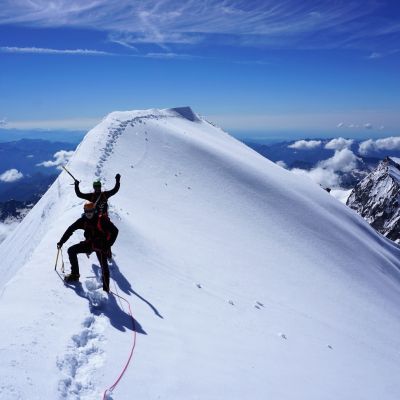
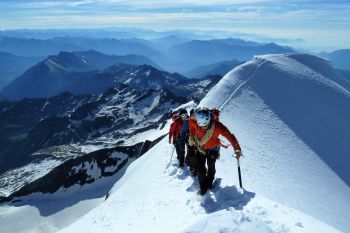
Friday. Our final ascent is the Mönch – the shortest and most accessible of the 4000ers in this region. The climbing is continually interesting, with scrambling and short pitches over rock or mixed ground, leading to a steeper snow or ice slope and a fine, narrow snow crest up to the summit. We descend by the same route to the hut and continue down to the Jungfraujoch railway, which takes us back to Grindelwald and our transport back to Leysin. Saturday morning. Breakfast at the hotel is included before departure. |
|
| |
| |
|||||||||||||||||||||||||||||||||||||||||||||||||||||||||||||||||||||||||||||||||||||||||||||||||||||||||||||||||||||||||||||||||||||||||||||||||||
|
|||||||||||||||||||||||||||||||||||||||||||||||||||||||||||||||||||||||||||||||||||||||||||||||||||||||||||||||||||||||||||||||||||||||||||||||||||||||||
Home | About ISM | Book a Course | News & Reports | Sitemap | Links | Contact ISM |
|||